2002 –
Exodus
Marco Scotini 2004
Out emerged as a response to the governments decision to carry out this project defined by top-down planning, the typical urban expression of “Big Government”. OUT has been able to establish itself as an open platform for social mobilisations composed of neighbourhood associations, popular and creative forces, the remains of the industrial past, the new residents, in short, the real city.
Exodus is one of the key words in the post-Fordist lexicon. It has been transformed from a classic category in the thinking of the Italian worker of the seventies to a tool that is now decisive in the interpretation of practices of all kinds within the new global order: modes of production, communications techniques and lifestyles. Today, an exodus not only evokes the emigration image; it has been reduced to an ordinary condition, and, as such, is susceptible to being transformed into a new space for politicization. According to Paolo Virno, the exodus, far from being a phenomenon that exonerates one from obligations and responsibilities, is one of the most productive and affirmative contemporary processes. Only through abandonment (thus, through a negative practice) can “pure belonging” be defined, which is to say the belonging that in itself emancipates one from all the classic collective identities and from the genres to which it is possible to belong: traditions, peoples, roles, and social classes, etc. In short, the extended exodus is seen not as a space of removal, but as a space that is constructed upon each occasion in order to foster a contingent, empirical exit. It is the place in which one accomplishes the act of desertion, a space totally outside of conflict (“voice,” as Hirschman would say).
When we speak of OUT, the office installed by the artist Bert Theis in Milan in 2002 as an urban-scale “community service,” it forces us to engage in this kind of deliberation. We might even start with the name of the project itself. Its logotype, three black “Arial” type letters on a white background make up the acronym for the “Office of Urban Transformation.” But the English word “out” also means “exit.” Even if it doesn’t express a precise goal, it at least suggests a program. So what is the true force of the project in practice?
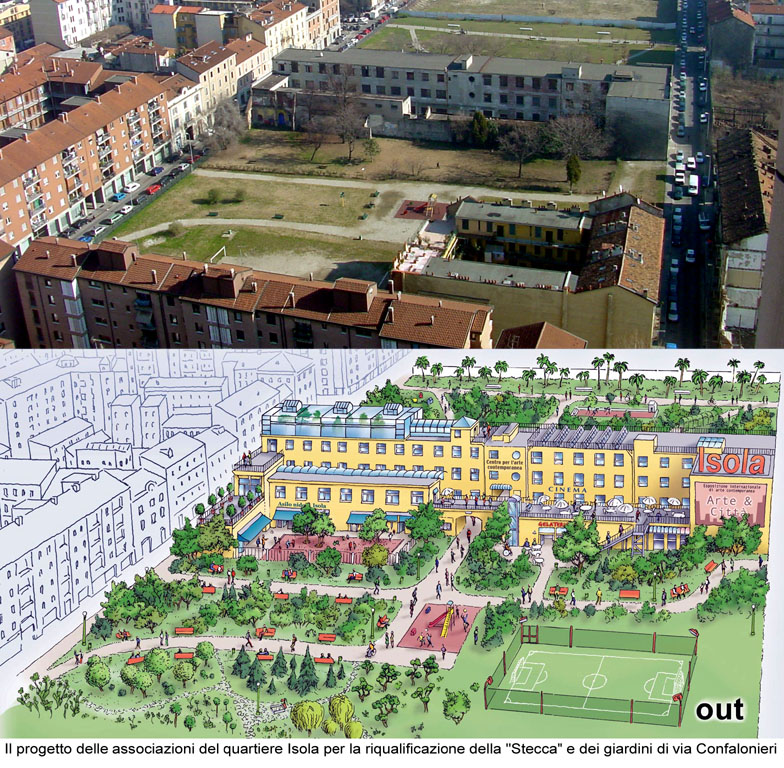
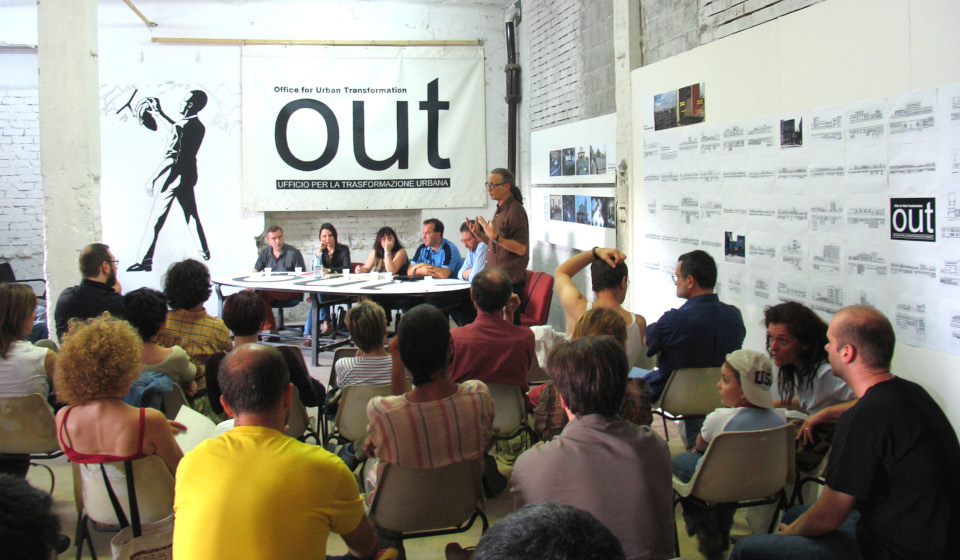
OUT, whose headquarters opened in Milan and extended to Mexico City in 2004, is a flexible, collective work experience that brings together artists, architects, and cultural and popular groups, all of whom are participants in social activism. Its place and date of birth are indications of its emerging situationist character that enables it to locate itself outside of a generalizing vision and, at the same time, within the city’s direct, concrete experience. The office space itself constitutes an occupation of an old factory building owned by the City Hall of Milan that was about to be demolished. It is located in the Isola (island) neighborhood near the downtown area in an urban void whose future has remained unsolved for many years. Since the nineties it has been threatened by a plan that would radically change the urban morphology and support only the leading sectors of Milan’s economy, such as the “Fashion City” project. The rest of the buildings would be utilized as a new regional public administration headquarters. OUT emerged as a response to the government’s decision to carry out this project defined by top-down planning, the typical urban expression of “Big Government.” OUT has been able to establish itself as an open platform for social mobilizations composed of neighborhood associations, popular creative forces, those who are left over from the industrial past, the new residents, in short, the real city. Bert Theis has installed himself in a context in which a number of different forces are now acting, a space for people that Holston would define as the “insurgent citizenry.” The artist intends to play a catalytic role, that of a coordinator who, in the best of cases, functions as a mediator between groups with opposing interests. He or she doesn’t act as their representative before government officials, given that current forms of social mobilization do not require answers from authorities. Thus, we may speak of an exodus from the institutions, of the immediate appropriation of productive modes of organization. In this sense, Theis’s strategies are in line with the operational vision of the most radical sector of contemporary artists, including Maria Eichhorn, Superflex, Christoph Schäfer, and others. Nevertheless, OUT and some earlier projects related to it (Philosophische Plattform, Münster 1997) propose a physical space of undetermined use that is subordinate to processes involving people and their efforts to initiate projects, organize, build. The artist provides the framework for these activities. One representative example consists of images elaborated by OUT to support the activities of neighborhood organizations. Likewise, the collective project for remodeling the ex-factory stemmed from a consultation among its inhabitants, each of whom presented a written or illustrated proposal based on a common outline. In short, a long line of artists have collaborated in interior and exterior projects (like the parks on Confalonieri Street.), always with collective forms of self-organization. The Office of Urban Transformation is based on three basic principles necessary to foster reflections on the city: analyzing, dreaming, transforming. The principles are closely related to the three points put forth by Lefebvre in La Production de L’Espace. They are rooted in the office’s fundamental work: providing a framework for numerous case studies, which converts OUT into a space that is nomadic and, at once, specific. One of its most recurrent themes, that of “dreaming the city,” led to conceiving of it is a “city-jungle.” This is also the case of the collages that feature Milan, Genoa, Tirana (in Albania) and Munich (in Germany). They combine visionary images of indefinite natural realities with the architecture of the cities in question, mixing a radical kind of eco-urbanism with the use of new telecommunications technologies.
Western post-communist cities are not the only objects of study. Since 2004 the nineteenth-century Santa Maria La Ribera neighborhood in Mexico City has been a focal point of the office’s architectonic research and social activation. Although its own set of problems is very different from that of the Isola neighborhood, it shares the will to participate in the historical rescue of the physical remains of the past. In fact, the OUT-Mexico space has a new headquarters and logotype in Mexico City that are the “negative” version of the original.
First published in the Mexican magazine “Espacio”, may 2005
out-put
Interview of Bert Theis for the presentation of “Out” at the Ciocca Contemporary Art, Milan, in 2004
By Noah Stolz, curator.
Contributions and collaborations by: Giulia Alberio, Lorenzo Rocha Cito, Cantieri Isola, Alessandro di Giampietro, Marcello Gianoli, Noah Stolz, Bert Theis, Marco Vaglieri, Renaud Codron.
N.S : Out in english means “outside”, but depending on the context of the discussion it could also indicate the state of something which is “over”, and then you can also find it in composed words like outset, outline, outlive, outlook, output and so on. At the end out is the opposite of in. For you what does it mean ?
B.T : First of all Out is the abbreviation of “office for urban transformation”. But the fact is that the space in which Out exists and develops its activities is in a precarious situation. We indeed are threatened with expulsion and this building (commonly named by the inhabitants of the Isola neighborhood in which it is located) “la stecca degli artigiani” is about to be knocked down. And so we are threatened to be pushed “out”.
N.S : How and with which proposals was Out born ?
B.T : Putting the decision, of opening an office inside of “la stecca degli artigiani” into practice, went out in november of last year. This choice was essential to me for two reasons. The first one is pragmatical : for two years and a half I promoted the “Isola art project” along with Stefano Boccalini, the A12 group and other artists; at this time already we were working with the laboratory of the quarter “Cantieri Isola”. The artistic project on this quarter really took off on a national and international level with the creation, one year ago, of the association “Isola dell’arte” (art island) of which Out is part since the beginning. The artistic activities and the debates were focused on the area of “la Stecca” and its gardens, which is located between the Confalonieri and the De Castillia streets and which is threatened of destruction by the Milano town council and its Garibaldi-Repubblica urbanistic project. I had understood that an instrument was missing, instrument which could help the people and the associations of this context to surmount the obstacles that divided them. The creation of an office that functioned without any permanent staff but with free collaborators permitted to work more efficiently and, according to the necessities or the chances, with a prolific team able to open up new discussions more adapted to the context. The second one concerns a theorical reflection on art. I think that today it is necessary to find forms of collaboration between the different forms of intelligence and creativity. The artists can unite with architects, philosophers, scientists, designers, photographers, cartoonists,etc.. to produce together a new form of art. Its field of intervention and diffusion shouldn’t be limited to the contemporary art world, which is very marginal, but should rather extend itself to all the sectors of the society.
N.S : What does it mean concretely ?
B.T : Out move in three different grounds : 1. to analyse and study urban and social situations, 2. to imagine and dream about transformations of these situations, 3. to take the initiative to activate these transformations. The presented slide show expresses more clearly these three points by visual associations. The works of Giulia Alberio (architect) on the Sao Paolo public space, of Lorenzo Rocha Cito (architect and architecture critic) on Mexico DF, of the “Cantieri Isola” on the Isola quarter of Milano and of Marcello Giannoli (architect and artist) on the relation between war and architecture develop in different ways the first of these three points.
In opposite the projects developped in the second point and in relation with the dream of the transformation are by example the pictures of the nudes (censored) , through which Alessandro di Giampietro (fashion photographer and artist) proposes a fashion photography without any models or any clothes, or also the one hundred portraits work signed by Alessandro and me and which has to do with two points : to know and to transform. By carring out these portraits we’ve created an X-ray photography of the Stecca microcosm. By exhibiting them in Out we’ve contributed to favour the meeting and the collaboration of people who used to frequent “la Stecca” since a while but without ever seeing each other. In opposite the different drawings made by Marco Vaglieri (artist and illustrator) and me have to do with several points of all the three aspects of our research : to analyse, dream and transform.
N.S : Do statements, or any association ,exist ?
B.S : There aren’t any written statements but a consensus about how to proceed. Out is an office, a concept, a way to work. It isn’t a structured group. Each Out collaborator keeps its own identity. For each product of Out, or presented by Out, informations about its producer is given.
N.S : If in the future “la stecca degli artigiani” should effectively be knocked down, what would happen with Out ?
B.T : Out was born at Isola, but isn’t limited at it. The presented slide show for this occasion reveals how we’ve worked, in collaboration with architects, artists and a street theater troupe, during the transformation of the Piazza di Monsummano Terme in Toscana. It was within the context of the networking organised by Marco Scotini. Moreover, as I already said it, works concerning other urban contexts had been presented at Out. The main interest of our office is to develop a possibilty of interconnexions between the marginal entities and realities, which contrast with the legal and official net but which are necessary to the sociability. Then in case if, in opposite with what you said, the associations of the Isola quarter win their battle, Out would leave its space to the Stecca and would move somewhere else, probably in a tent. We are nowadays working with Lorenzo Rocha Cito in order to open next month a branch of Out in Mexico City.