Who uses the space?
A project of the Visual Arts course at NABA curated by Marco Scotini
Lohkchat by Yang Jiechang
Isola Art Center presents the work ‘Lohkchat, Rise and Fall’ by the Chinese artist Yang Jiechang.
LOHKCHAT is a bad word in Cantonese. Its meaning and use, however, are quite universal. Facing disaster and catastrophe, natural or cultural, man often is powerless. Immobilized he looks for ways how to deal with his impotence. High-tech is one way. The most primitive and direct way is swearing. From this perspective LOHKCHAT is more than a bad word in Cantonese, it is a kind of philosophy of life – as Yang Jiechang believes, typical of local Cantonese culture. It is not fatalism but rather a kind of compliance with and understanding of the unchangeable cycle of life. This understanding might be one reason for the simplicity and straightforwardness of local Cantonese culture.
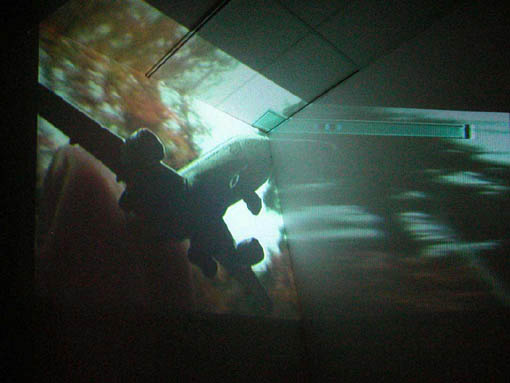
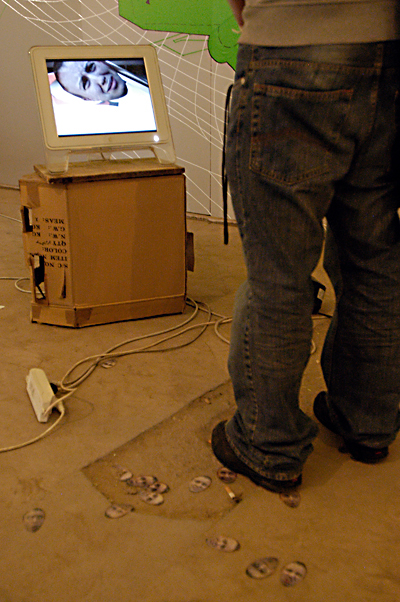
Yang Jiechang’s multimedia installation Lohkchat re-enacts a man-made catastrophe. He juxtaposes high-tech (aircraft and plan of a modern airport) with his simple local Cantonese philosophy of life. In the video that is part of the installation the artist’s hand appears huge, holding a tiny plane, a toy in the grip of an omnipotent, somehow supernatural palm. Lohkchat is a kind of humorous anecdote relating the human struggle against fate and all those forces beyond human control. In Chinese folklore this struggle is best embodied in the figure of the monkey king Sun Wukong, who wanted to jump out of Buddha’s omnipotent palm. I am sure, in the end, aware that he again had failed, and buried under Buddha’s “Five Finger Mountain”, Sun Wukong must have whispered something like “Lohkchat”.
Martina Köppel-Yang 2003
Born in Canton, Yang Jiechang (1956, Foshan, China. Lives and works in Paris) belongs, with Chen Zen and Huang Yong Ping, to the first generation of Chinese artists who gained visibility in the West thanks to exhibitions like “Magiciens de la terre” curated in 1992 by Jean Hubert Martin. Like most of the artist on the Guangzou art scene, Jiechang produces work with strong political overtones. His work was first seen in Italy at the Venice Biennial in 2003, in the section curated by Hou Hanru.
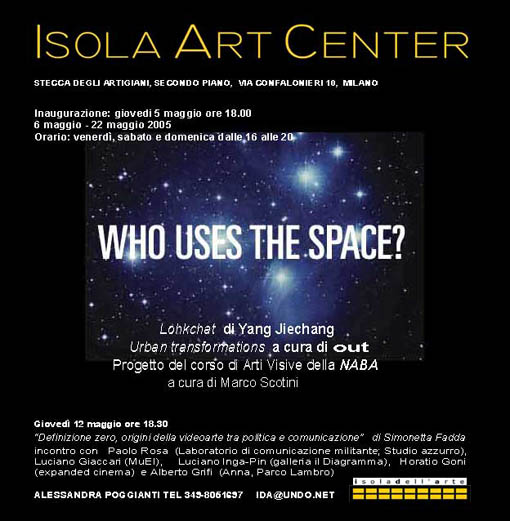
Who uses the space?
A project of the Visual Arts course at NABA curated by Marco Scotini
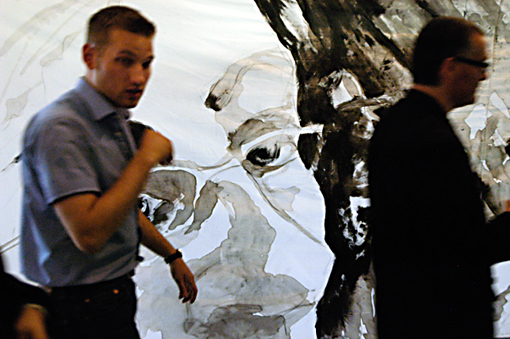
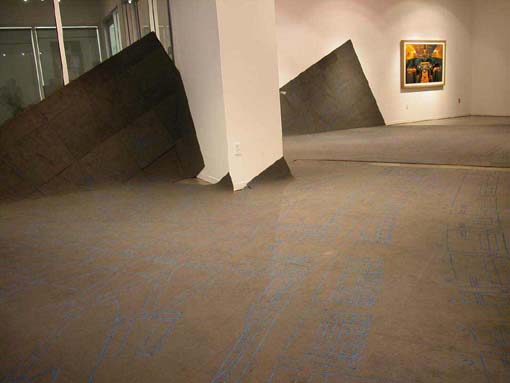
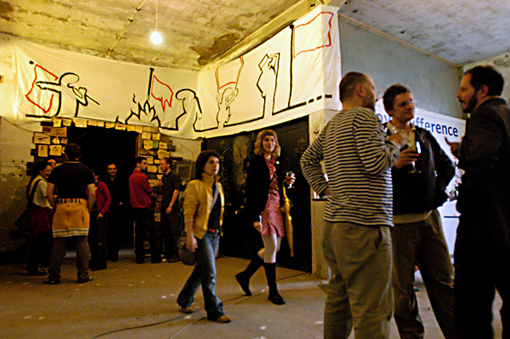
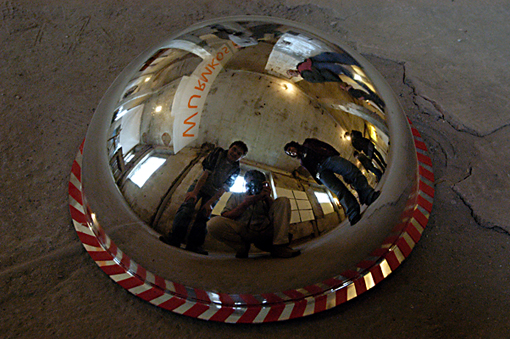
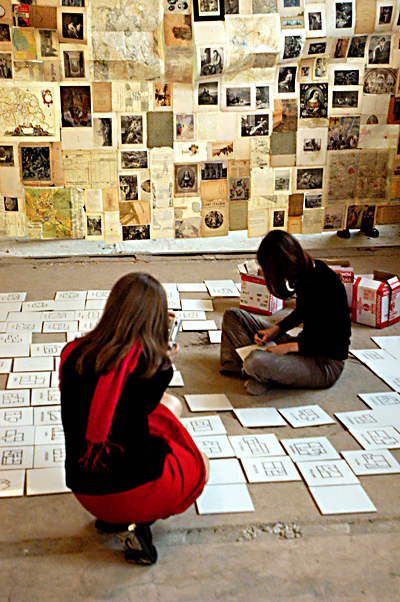
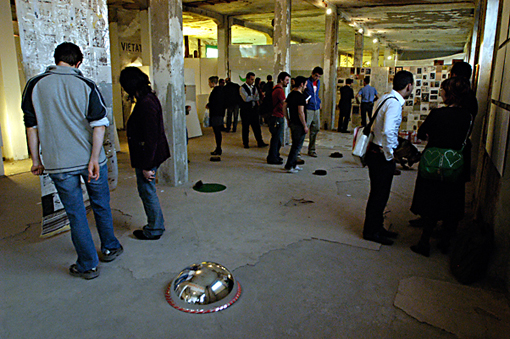
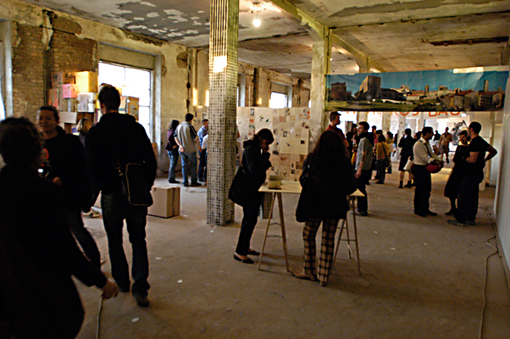
The project Who uses the space? conceived for an alternative art structure like Isola Art Center is intended as a reflection on the conditions that govern and regulate space while producing it at the same time. Between the space of representation (painting, installation, video, etc.), that of the museum and that of the city, is the same ordering relationship at work, or can we see them as independent dimensions of spatial activity? When in 1975 Marcel Broodthaers published a small book entitled La conquête de l’espace: Atlas à l’usage des artistes et des militaires (The Conquest of Space: Atlas for the Use of Artists and the Military), he offered a definitive response to the problem. The atlas is a slender tome containing the profiled maps of nations all reproduced in the same format, one per page. Broodthaers, more than any other artist, challenged the supposed neutrality of the museum as institution, making it become – in the fiction of his Musée d’Art Moderne – a place where children are not allowed (Museum enfants non admis), the display of geometrically defined administrative roles (a rectangular director), a type of spatial policing, etc. The question Who uses the space? is now posed by a group of young artists participating in what is practically their first exhibition. Unlike previous generations, this one no longer asks itself about the essence of art, but about its historical-cultural and functional character. Degree zero is not a blank canvas or the “geometric design”, but the radical question on “who” produces space and “how”. And the space is the space of life as opposed to that of economics, collective space, space defined by differences, the space of exclusion, the space of negotiation, that of integration and, above all, the transforming space of migration. In this sense, intervention in a container of action and self-representation like the Isola Art Center is already an operative direction, a choice of position. Willem Sandberg said that in a museum one should have the sensation of playing ping-pong. Today we think of the museum as an open place of interaction and mobilization: above all as a space, among others, of transformation. The project conducted in the Visual Arts program of the Nuova accademia di Belle Arti of Milan (NABA) and curated by Marco Scotini involves students from the courses taught by Marcello Maloberti, Stefano Boccalini, Antonella Bruzzese (Gruppo A12), Dimitris Kozaris. Participants: Antonio Barletta, Malin Baumann, Marco Bongiorni, Valentina Brenna, Lisa Chiari, Tommaso Garner, Magne Ilsaas, Noga Inbar, Cristina Mariani, Alberto Montorfano, Halldor Sturluson, Vanessa Tagliabue, Lorenzo Tamai, Ian Tweedy, Lorenzo Zelaschi
Urban transformations
out presents new materials on the office’s activities in Milan, Mexico City, Tirana and other cities. The materials prepared by Comitato “I Mille” on the struggle in the Isola neighborhood to defend public spaces are also on permanent display.
On Sunday a palm tree will be planted in the park on Via Confalonieri.
Appointments: Thur 12 May 18.30
Curated by Simonetta Fadda, with Fabiola Naldi and Alessandra Pioselli
“Definition zero: origins of video art, between politics and communication”:
For the reprinting of the book by Simonetta Fadda “Definizione zero, origini della videoarte tra politica e comunicazione”, Paolo Rosa (Laboratorio di comunicazione militante; Studio Azzurro), Luciano Giaccari (MuEl), Luciano Inga-Pin (galleria il Diagramma), Horatio Goni (expanded cinema) and Alberto Grifi (Anna, Parco Lambro) will talk about their experiences with video in the 1970s. The book examines the way video has emerged as an art medium around the world, with a “committed” and “radical” approach that has partially been incorporated by the art world at the level of modes of presentation and the forms applied to works.