Lohkchat by Yang Jiechang
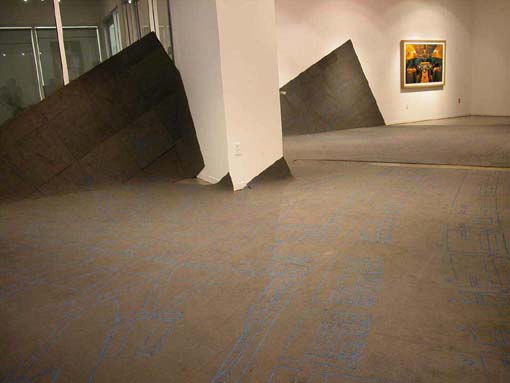
Isola Art Center presents the work ‘Lohkchat, Rise and Fall’ by the Chinese artist Yang Jiechang.
LOHKCHAT is a bad word in Cantonese. Its meaning and use, however, are quite universal. Facing disaster and catastrophe, natural or cultural, man often is powerless. Immobilized he looks for ways how to deal with his impotence. High-tech is one way. The most primitive and direct way is swearing. From this perspective LOHKCHAT is more than a bad word in Cantonese, it is a kind of philosophy of life – as Yang Jiechang believes, typical of local Cantonese culture. It is not fatalism but rather a kind of compliance with and understanding of the unchangeable cycle of life. This understanding might be one reason for the simplicity and straightforwardness of local Cantonese culture.
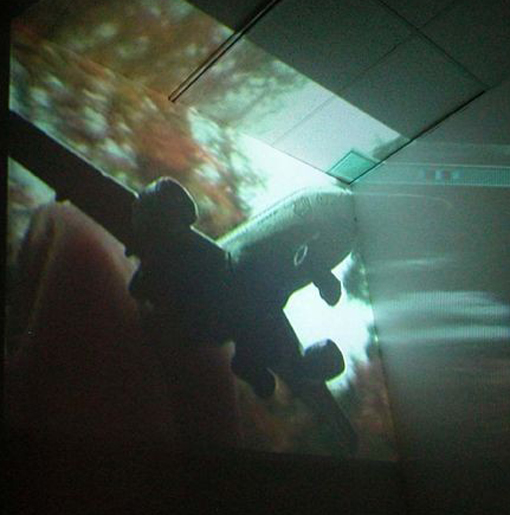
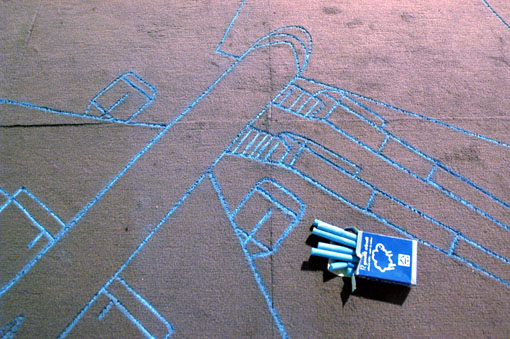
Yang Jiechang’s multimedia installation Lohkchat re-enacts a man-made catastrophe. He juxtaposes high-tech (aircraft and plan of a modern airport) with his simple local Cantonese philosophy of life. In the video that is part of the installation the artist’s hand appears huge, holding a tiny plane, a toy in the grip of an omnipotent, somehow supernatural palm. Lohkchat is a kind of humorous anecdote relating the human struggle against fate and all those forces beyond human control. In Chinese folklore this struggle is best embodied in the figure of the monkey king Sun Wukong, who wanted to jump out of Buddha’s omnipotent palm. I am sure, in the end, aware that he again had failed, and buried under Buddha’s “Five Finger Mountain”, Sun Wukong must have whispered something like “Lohkchat”.
Martina Köppel-Yang 2003
Born in Canton, Yang Jiechang (1956, Foshan, China. Lives and works in Paris) belongs, with Chen Zen and Huang Yong Ping, to the first generation of Chinese artists who gained visibility in the West thanks to exhibitions like “Magiciens de la terre” curated in 1992 by Jean Hubert Martin. Like most of the artist on the Guangzou art scene, Jiechang produces work with strong political overtones. His work was first seen in Italy at the Venice Biennial in 2003, in the section curated by Hou Hanru.